Edelweiss Altiva’s 3 SIFs: Understanding the Different Strategies
SIF Edge
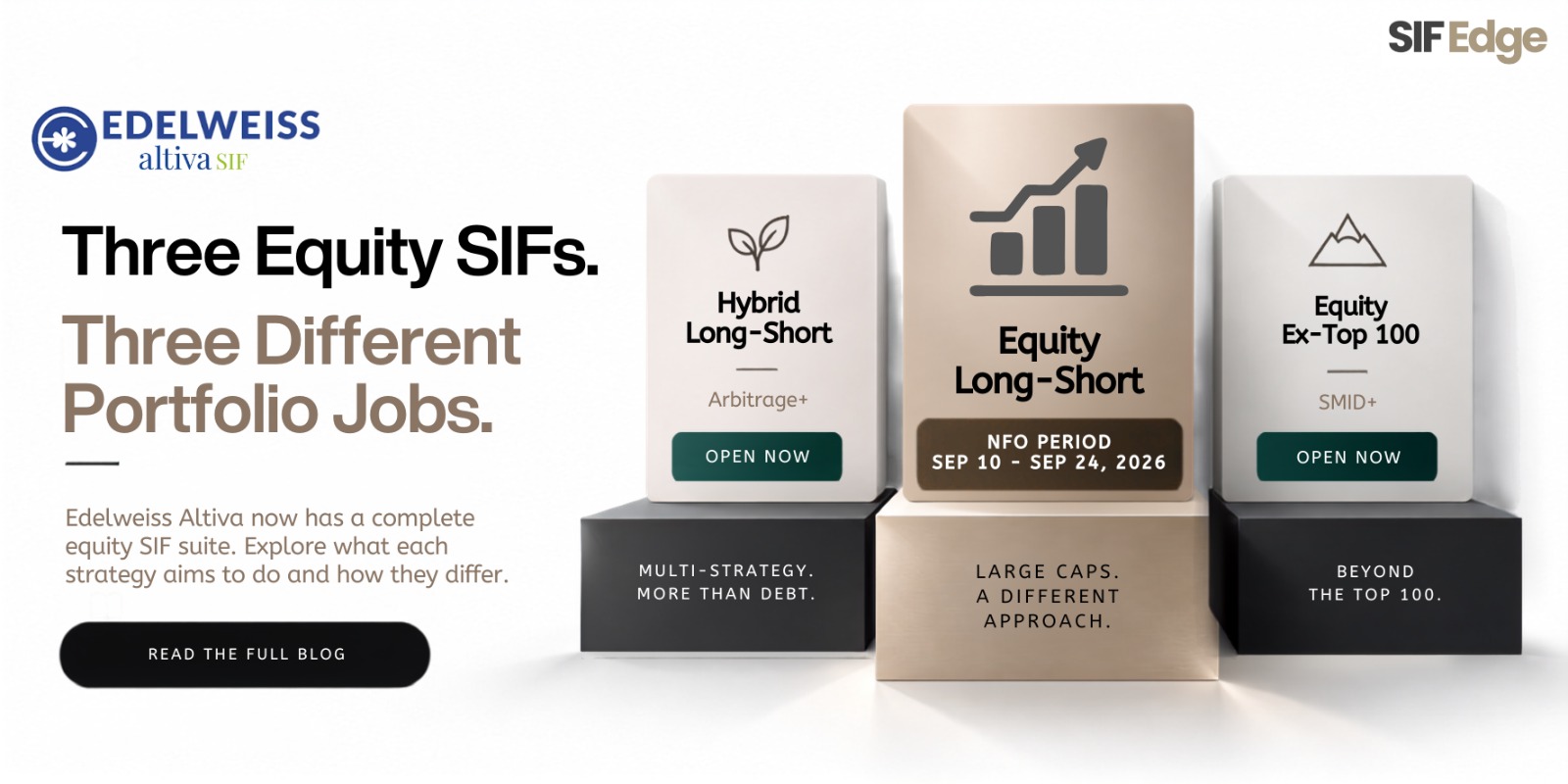
Edelweiss Altiva has launched its Equity Long-Short Fund, with the NFO opening on 10 September 2026 and closing on 24 September 2026.
With this launch, Edelweiss now has three Altiva SIF strategies:
- —Altiva Hybrid Long-Short Fund
- —Altiva Equity Long-Short Fund
- —Altiva Equity Ex-Top 100 Long-Short Fund
All three use the Long-Short framework and derivatives, but the underlying portfolios are quite different.
So, rather than looking at them simply as three SIFs from the same AMC, I think it is useful to understand what each strategy is trying to do, how the portfolios are constructed, where the return potential comes from, and what risks come with that approach.
A simple way to think about the three strategies is:
Arbitrage+ | Large Cap+ | Mid Cap+
The “+” represents the additional return or risk-management engine being layered onto the underlying portfolio.
1. Hybrid Long-Short: Arbitrage+
The Hybrid Long-Short is the most multi-strategy of the three.
Its core return engines are arbitrage and fixed income, supplemented by derivatives and special situations.
The August 2026 portfolio gives a good picture of the approach. Around 42% was allocated to fixed income, another 42% to cash-future arbitrage and covered calls, and around 13% to other derivative strategies.
The strategy also had exposure to REITs/InvITs and special situations.
So the underlying thesis is quite different from a conventional equity strategy. The portfolio is trying to generate returns from multiple sources rather than primarily from equity-market direction.
That makes the key question around this strategy:
How can a portfolio combine arbitrage, fixed income, derivatives and special situations to create a diversified return profile?
The management team reflects this construction.
Bhavesh Jain, with around 17 years of experience, and Bharat Lahoti, with around 18 years, manage the equity side, while Dhawal Dalal, with around 26 years, and Kedar Karnik, with around 19 years, bring fixed-income expertise.
In terms of return expectations, this isn't a strategy where the primary objective is to capture the full upside of an equity-market rally.
Its disclosed positioning is more income-oriented and relatively lower-volatility, with arbitrage and fixed income forming the core return engines.
2. Equity Long-Short: Large Cap+
The newly launched Equity Long-Short Fund addresses a different problem.
Large caps already form the core of many Indian equity portfolios.
The challenge is that generating incremental alpha through stock selection can become difficult in a highly researched universe. Large companies have extensive analyst coverage and significant institutional participation.
But large caps also have an important characteristic:
Liquidity and an active derivatives market.
That gives the investment strategy another tool.
Instead of relying entirely on stock selection, the manager can use permitted derivative strategies such as covered calls, straddles and strangles as an additional return or risk-management layer.
The intended long-term portfolio is approximately 80% large cap and 20% mid and small cap, with equity exposure of 80–100% and debt/cash potentially making up the balance.
This is why I find the Large Cap+ description useful.
It isn't simply about adding more large-cap exposure.
The thesis is:
Large-cap equity + stock selection + derivative strategies
The strategy documents describe the objective as seeking alpha with relatively lower volatility and measured drawdowns, resulting in potentially better risk-adjusted returns.
There is also an important trade-off to understand.
A derivative overlay can change the payoff profile of the portfolio. In a very sharp market rally, the strategy may not participate in the entire upside of the underlying equity market.
So the proposition should not be interpreted as “large-cap returns plus extra returns in every market.”
It is more accurately understood as an attempt to enhance the risk-return characteristics of a large-cap-oriented portfolio.
The fund is managed by Bhavesh Jain and Bharat Lahoti. Bhavesh has around 17 years of experience and Bharat around 18 years, with backgrounds spanning factor investing, quantitative and fundamental research, portfolio management and risk-adjusted strategies.
Since this is a new fund, there is no live performance track record yet. Therefore, any future return outcome will need to be evaluated based on actual portfolio implementation rather than the stated strategy alone.
3. Equity Ex-Top 100: Mid Cap+
At the other end of the spectrum is the Equity Ex-Top 100 Long-Short Fund.
Here, the starting point isn't large caps.
The strategy focuses on companies outside the Top 100, broadly covering the 101–750 market-cap universe.
It is designed as a high-conviction 35–45 stock SMID portfolio, with the stated allocation being 90–100% to the SMID universe and the balance potentially in derivatives, large caps and cash.
The actual August portfolio was:
- —65% Small Cap
- —28% Mid Cap
- —7% Large Cap
That makes the strategy fundamentally different from the Equity Long-Short Fund.
The Equity Long-Short strategy starts with the large-cap universe and attempts to enhance it.
The Ex-Top 100 strategy deliberately moves beyond that universe and builds a concentrated SMID portfolio.
The investment process is bottom-up, focusing on high-conviction opportunities with earnings visibility, improving return profiles, attractive valuations and strong fundamentals.
The trade-off is the risk profile.
The strategy was classified at Risk Band Level 5 in the August material.
The fund is managed by Trideep Bhattacharya and Nikhil Gada.
Trideep brings more than two decades of equity-investing experience, including experience in alternate equities, while Nikhil has around 14 years across equity research and fund management.
The return engine here is therefore much more closely linked to SMID stock selection.
That also means the range of possible outcomes can be wider than in the Hybrid strategy.
The interesting part: all three use derivatives
This is probably the easiest place to misunderstand the three strategies.
All three use derivatives.
But derivatives are not the investment thesis in themselves.
In Hybrid, derivatives sit alongside arbitrage and fixed income as part of a multi-strategy portfolio.
In Equity Long-Short, derivatives are used as an overlay on a large-cap-oriented equity portfolio.
In Ex-Top 100, derivatives provide additional flexibility around a high-conviction SMID portfolio.
So the same instrument can be doing very different work.
Same tool. Different portfolio. Different purpose.
Does this mean there is no overlap between the three?
Not exactly.
There is some overlap in individual holdings.
For example, CreditAccess Grameen, Coforge and Bharat Dynamics appear in both Hybrid and Ex-Top 100.
But the position sizes can be very different.
CreditAccess Grameen was around 0.26% in Hybrid versus 3.25% in Ex-Top 100.
And this is an important distinction when comparing portfolios.
Same stock does not mean same exposure.
A stock can be a small position within a broad multi-strategy portfolio, while the same stock can represent a meaningful high-conviction position in a concentrated SMID portfolio.
So portfolio overlap needs to be evaluated through position size, concentration, market-cap exposure and the role of the holding, rather than simply by counting common names.
So what kind of returns can investors expect?
This is where I would avoid putting a specific return number on these strategies.
There is no assured return, and the new Equity Long-Short Fund has no historical performance track record yet.
Instead, the better way to think about expected outcomes is through the source of returns.
For Hybrid, the return profile is intended to come primarily from arbitrage, fixed income, carry, derivatives and special situations. This points towards a relatively lower-volatility, income-oriented profile compared with the two equity-focused strategies.
For Equity Long-Short, the return profile is intended to come from large-cap equity exposure, stock selection and the derivative overlay. The objective is to seek a better risk-adjusted outcome rather than simply maximise participation in every market rally.
For Ex-Top 100, returns are much more dependent on SMID equity selection. That creates greater potential for both gains and drawdowns.
So rather than asking:
“Will this fund generate 12%, 15% or 20%?”
I think the more useful question is:
“What is actually generating the return?”
That tells you much more about the strategy.
Where do these three fit in a portfolio?
This is where the three strategies become easier to differentiate.
Someone looking for multiple return sources with relatively lower dependence on equity-market direction would be looking at the Hybrid strategy.
Someone who already has substantial large-cap exposure and is interested in a different way of managing that allocation through stock selection and derivatives would be looking at Equity Long-Short.
Someone looking for high-conviction exposure to the SMID universe beyond the Top 100, and who understands the higher risk associated with that exposure, would be looking at Ex-Top 100.
This doesn't mean one is universally more suitable than another.
They are designed around different portfolio roles.
One more thing: the manager matters differently in each strategy
I wouldn't compare the managers simply by asking who has the longest experience.
The more useful question is whether their experience is relevant to the strategy they are managing.
Hybrid brings together equity/factor expertise and fixed-income expertise, which matches its multi-strategy construction.
Equity Long-Short has Bhavesh Jain and Bharat Lahoti, whose backgrounds span factor investing, quantitative and fundamental research and portfolio management.
Ex-Top 100 has Trideep Bhattacharya and Nikhil Gada, bringing a strong equity research and high-conviction investing orientation to the SMID strategy.
Different return engines require different skill sets.
The simplest way to understand all three
If I had to reduce the entire Altiva range to three questions, it would be:
Looking to diversify your return sources?
Look at the Hybrid Long-Short strategy and its Arbitrage+ approach.
Already have large-cap exposure and interested in enhancing that portfolio construction?
The Equity Long-Short strategy and its Large Cap+ approach address that problem.
Looking for high-conviction exposure beyond the Top 100?
The Ex-Top 100 Long-Short strategy provides the Mid Cap+/SMID approach.
Three strategies.
Three different portfolio constructions.
Three different return engines.
And that, to me, is the more interesting aspect of the Altiva platform.
The important question isn't simply “Which SIF has the highest return potential?”
It is: “What role does this strategy play in the portfolio, and where is its return actually coming from?”
FAQs
Are all three Altiva SIFs equity-oriented?
No. Hybrid has substantial fixed-income and arbitrage exposure, while Equity Long-Short and Ex-Top 100 are primarily equity-oriented strategies.
Which one has the lowest risk?
Among these three, Hybrid has the lowest disclosed risk positioning. That does not mean it is risk-free or capital-protected.
Which one has the highest return potential?
There is no reliable way to determine this in advance. Ex-Top 100 takes greater equity and concentration risk, which can lead to a wider range of outcomes, but higher risk does not automatically translate into higher realised returns.
If I already own a Nifty 50 or large-cap fund, what is different about Equity Long-Short?
Its stated proposition is not simply additional large-cap exposure. It combines large-cap-oriented stock selection with a derivative overlay intended to add another return/risk-management dimension.
Why does Ex-Top 100 have higher risk?
The portfolio is heavily exposed to mid and small caps and is concentrated in approximately 35–45 stocks. Both the market-cap exposure and concentration can increase volatility and drawdowns.
Do the three funds have completely different stocks?
No. There can be overlap in individual holdings. What differs is the portfolio weight, market-cap exposure, concentration and the role that a particular stock plays in the strategy.
Are derivatives used in the same way across all three?
No. Hybrid uses them as part of a multi-strategy framework; Equity Long-Short uses them as an overlay on a large-cap-oriented portfolio; and Ex-Top 100 uses them to provide additional flexibility around its SMID portfolio.
Can we estimate the additional return from derivatives?
Not reliably. The outcome depends on market conditions, volatility, pricing, execution and the specific derivative strategies implemented. The new Equity Long-Short Fund also has no live track record yet.
Are these funds substitutes for traditional mutual funds?
Not necessarily. Their structures and investment approaches are different, and their role depends on the overall portfolio and the investor's objectives and risk tolerance.
To track, analyse and compare SIFs, visit SIFedge.com.
Disclaimer: This article is for educational and informational purposes only and is based on publicly available scheme and portfolio information. It is not investment advice, a recommendation, solicitation or an offer to buy or sell any security or investment product. SIFs involve market, liquidity, concentration, derivative and other risks. Past performance, wherever applicable, is not indicative of future performance. The newly launched Altiva Equity Long-Short Fund does not yet have a live performance track record. Investors should read the scheme-related documents carefully and consider their own objectives, risk tolerance and circumstances before making any investment decision. The information presented here should not be construed as a guarantee or assurance of returns.
SIFedge is an initiative of Corewealth, an AMFI-registered mutual fund distributor (ARN: 301383).