What are Specialized Investment Funds (SIFs)?
A complete guide for Indian investors — SIF Edge
A typical mutual fund, whether equity, debt or hybrid/multi-asset, is allowed to take only long positions, with limited hedging permitted through derivatives for risk management. Pure vanilla mutual funds, in other words, cannot take meaningful short positions to benefit from falling markets or to cushion a decline in the broader market or a particular sector.
Markets, however, are non-linear. At any given point, different asset classes, sectors, stocks or debt instruments can move in opposite directions. As Indian markets have shown investors over the last 20 months, a long-only structure is not always capable of managing risk or capturing opportunity when markets fall. Unlike mutual funds, SIFs can take both long and short positions, enabling investors to potentially benefit in both rising and falling markets.
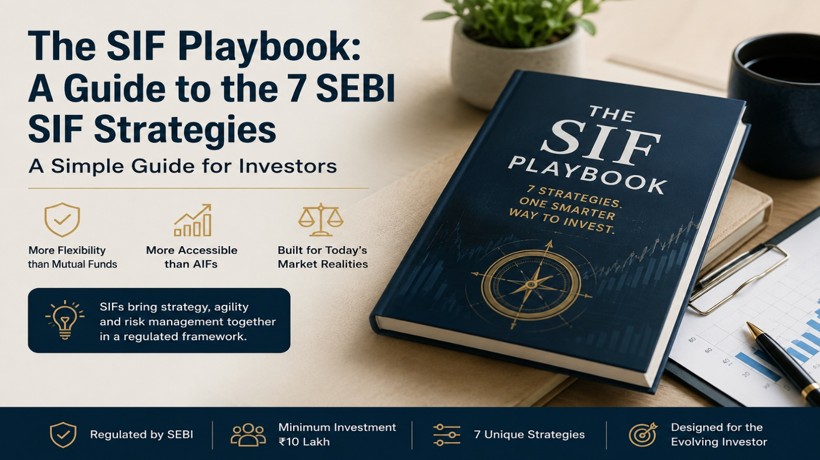
Regulatory framework
Specialized Investment Funds operate strictly within the regulatory framework laid down by SEBI, with defined rules on investment strategies, risk management and disclosures. While SIFs offer greater flexibility than mutual funds, they remain a fully regulated product, just like mutual funds.
Key points to note
- —Minimum investment: ₹10 lakh per investor.
- —PAN-based limit: Investments across all SIF strategies of the same AMC are aggregated to meet the ₹10 lakh requirement.
- —Separate from mutual funds: Investments in regular mutual fund schemes of the same AMC are not considered while calculating this limit.
- —Systematic facilities permitted: Investors can invest through SIPs, STPs and SWPs, provided the overall investment continues to satisfy the minimum ₹10 lakh threshold.
The greatest misconception about Specialized Investment Funds is that they are simply a PMS with a lower entry ticket of ₹10 lakh instead of ₹50 lakh. The accurate positioning of a SIF is as a distinct investment category of its own, not a smaller PMS and not a more aggressive mutual fund. In terms of investment strategy possibilities, it borrows some of the portfolio construction tools used by Category III AIFs.
Different products, different minimum thresholds, complementary products for an investor's basket: Mutual Fund → SIF → PMS → AIF
The tools available to the SIF industry
- —Long position: The traditional approach — SIFs can buy a security expecting it to appreciate over time.
- —Short position: Within prescribed limits, SIFs can take short exposure through derivatives, either to hedge risk or to benefit from a negative view on a sector or security, taking short positions on up to 25% of their net portfolio.
- —Use of derivatives: SIFs can use derivatives for speculation, hedging, reducing volatility, managing market exposure and implementing shorting strategies.
- —Dynamic asset allocation: SIFs may not have static allocation. Some can actively adjust exposure between equity, debt, cash and commodities as per the filed strategy.
- —Use of leverage: SEBI regulations strictly cap gross exposure at 100% of the fund's corpus, giving SIFs flexibility to use derivatives while preventing aggressive borrowing.
The seven SIF strategies
Equity oriented
- 1.Equity Long-Short: Broadly a flexi-cap style of investing with a long bias, while managing downside risk and generating returns using relative market opportunities.
- 2.Equity Ex-Top 100 Long-Short: Aims to capture opportunities beyond large-cap stocks (Top 100 by market capitalisation), while managing downside risk and generating returns using relative market opportunities.
- 3.Sector Rotation Long-Short: Must invest at least 80% of assets in equity and equity-related instruments across up to 4 sectors. Maximum short exposure through unhedged derivative positions cannot exceed 25% of the fund's net asset value, and all shorted stocks must belong to the sectors being shorted.
Debt oriented
- 4.Debt Long-Short: Fund managers buy bonds they expect to appreciate while simultaneously shorting overvalued bonds or taking offsetting positions across credit qualities.
- 5.Sectoral Long-Short: Allocates to bonds across multiple sectors, capping any single sector at 75%, and permits the fund manager to short-sell up to 25% of the portfolio using debt derivatives to pursue better fixed-income returns.
Hybrid / multi-asset
- 6.Hybrid Long-Short: The most popular strategy in the SIF category so far, mandated to hold at least 25% in equities and 25% in fixed income, using derivatives for the remaining portion.
- 7.Active Asset Allocator Long-Short (AAA): Dynamically shifts capital across equities, debt, commodities and real estate based on market attractiveness, combining long-term investments with tactical short exposure via derivatives to profit from downturns and hedge risk.
SIFs vs. Balanced Advantage Funds (BAFs): BAFs can manage falling markets only by lowering equity weight and moving cash into debt or arbitrage. SIFs can go a step further and actively short overvalued individual stocks to generate positive absolute returns during downswings.
How to choose the right SIF
Once an investor has decided that they understand SIF structures and which category of strategy works best for them, a few questions worth asking are:
- —Does the risk band match your comfort level?
- —Which asset management company and fund management team is executing the strategy?
- —Time frame — this is personal, though equity-oriented strategies require a longer investment horizon.
- —Portfolio fit — what role will this SIF play: core, tactical, or pure diversification?
- —Regular monitoring — reviewing the risk band and asset allocation changes over time.
Common mistakes investors make with SIFs
- —Investing simply because it's a new asset class tagged as an HNI product.
- —Assuming "hybrid" automatically means low risk.
- —Chasing NFOs without fully understanding the strategy.
- —Ignoring the risk band.
- —Choosing a SIF based only on historical returns.
- —Thinking SIFs are a direct replacement for mutual funds, just with a higher investable amount.